Benefits of Coworking: What You Actually Get, and Who It’s For
 08.06.2026
The benefits of coworking come down to 4 things you can measure:
- A lower and more predictable monthly cost than a traditional lease
- A workspace built for focused work
- Professional infrastructure you do not have to buy or maintain
- hort terms you can change as your headcount changes
Community and networking are real, but they are the least reliable benefit. This guide covers what coworking delivers in Manhattan, what it costs, and who should skip it.
TL;DR
- Coworking is shared, membership-based office space. You pay monthly for a desk with access to meeting rooms, internet, printing, and reception, with no build-out and no lease.
- Published Manhattan pricing spans roughly $200 to $650 per month for a hot desk and $350 to $950 for a dedicated desk, with budget independents at the low end and premium buildings at the top.
- The cost pays for itself fastest for people working outside the home 3 or more days a week, and for teams under 15 weighing a multi-year lease.
- Manhattan holds one of the largest coworking inventories in the country, with hundreds of locations, though coworking is still a low single-digit share of total office stock.
- Skip coworking if you spend the day on confidential calls, already have a quiet home office, or need a variable cost rather than a fixed monthly charge.
What Coworking Actually Means
Coworking is shared office space you rent by the month instead of by the lease. You get a seat, internet, printing, meeting room access, and a staffed front desk in a building you do not own or manage. Five terms come up constantly once you start comparing.
- Hot desk/flex desk/open desk: an unassigned seat in an open work area. You take whatever is free and pack up when you leave.
- Dedicated desk: a specific desk that stays yours. You can leave a monitor on it and lock things in a drawer.
- Day office: a private, lockable room you book by the day or half day, sized for 1 to 4 people.
- Meeting room: a bookable conference room, priced by the hour, with a screen and a door that closes.
- Virtual office: a commercial business address and mail service without a desk. You use the address publicly and receive mail on site.
Many Manhattan operators sell these separately, so you can combine a smaller monthly membership with occasional room bookings instead of paying for space you do not use.
The Core Benefits of Coworking, Explained
Predictable cost with a short commitment
A traditional Manhattan office lease requires a security deposit, a build-out, furniture, internet installation, insurance, and a term measured in years. A coworking membership requires a monthly payment. That difference is the most concrete of the benefits of coworking for any business that cannot forecast headcount two years out.
Short terms also mean you can change your mind. Hire three people and you add three desks. Lose a contract and you reduce your plan at the next billing cycle, rather than carrying empty square footage for another two years.
A space designed for one activity
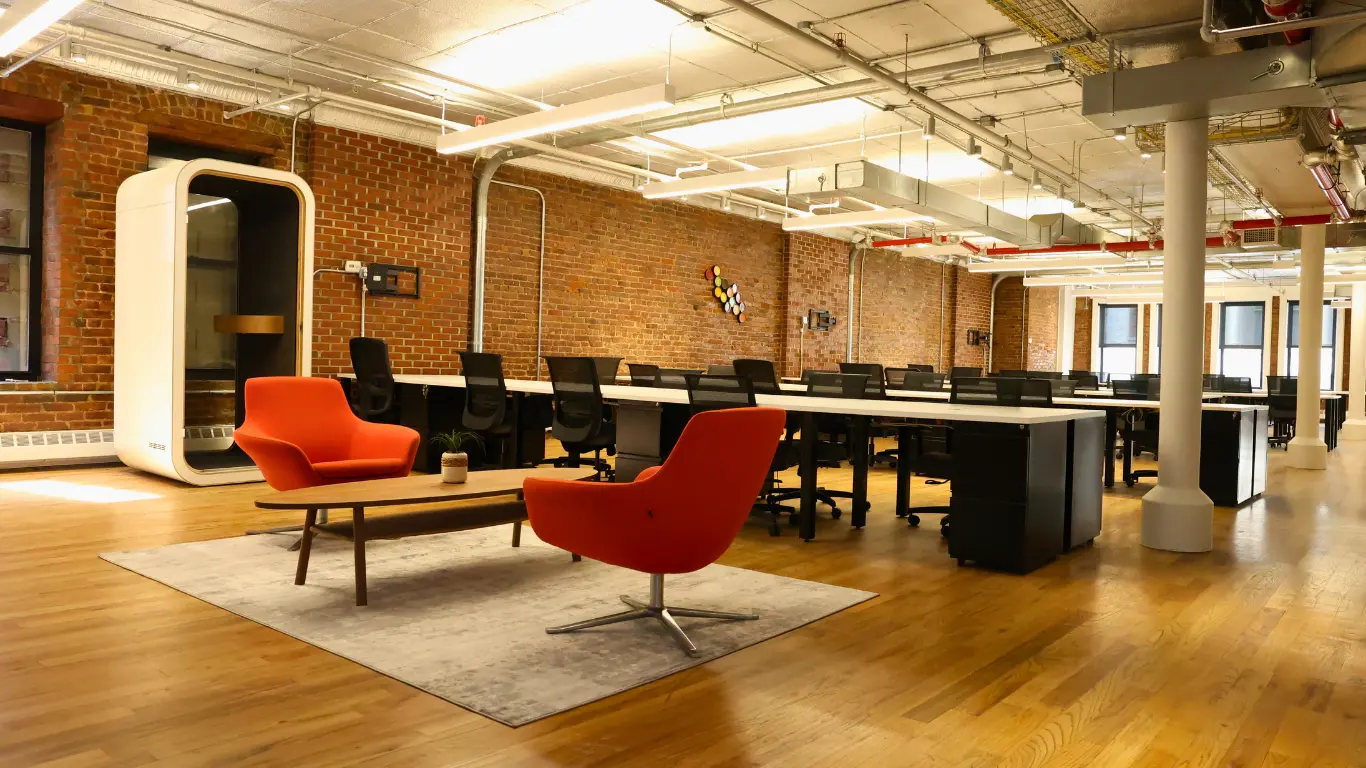
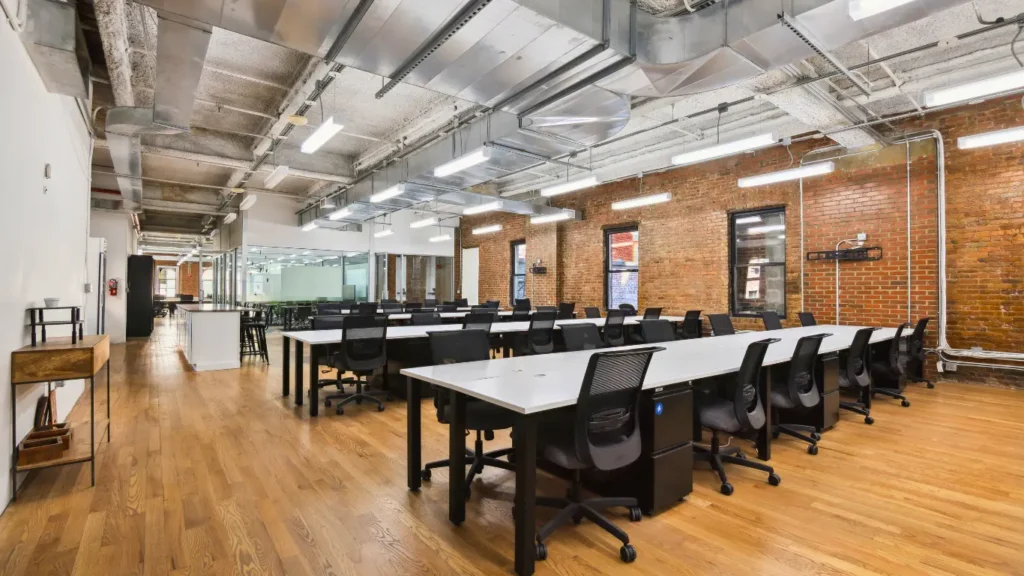
A home office competes with laundry, roommates, and deliveries. A cafe competes with noise, unreliable Wi-Fi, and an unspoken time limit on the table. A coworking floor is set up for work and nothing else: reliable internet, phone booths for calls, printing that works, and somewhere safe to leave a laptop while you get lunch.
Ask members why they renew and the answers are practical. Discussion threads in remote work communities consistently rank 24-hour access, quiet, and secure storage above networking. Those unglamorous benefits keep people paying.
Ergonomics you do not have to buy twice
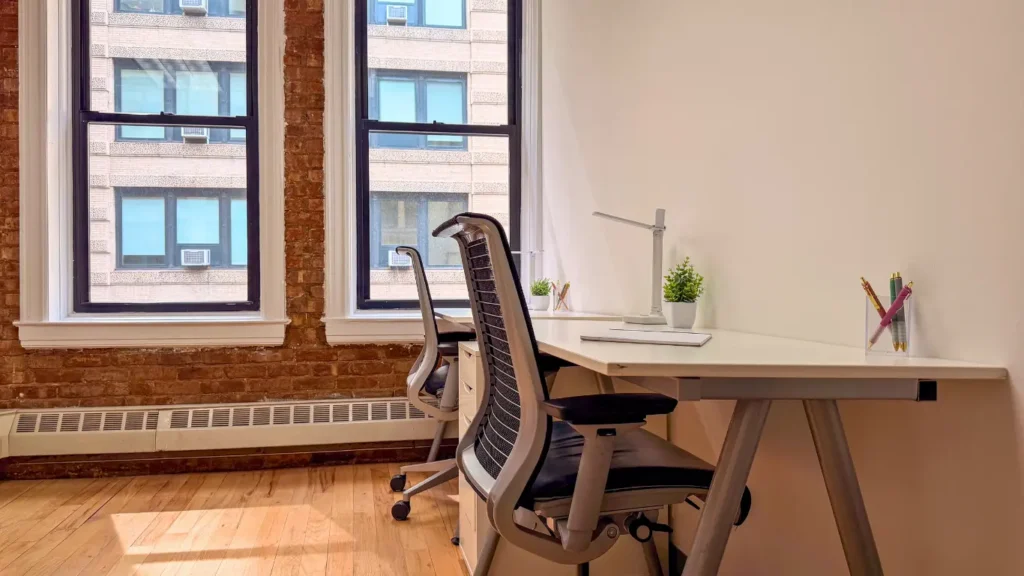
A supportive chair, a sit-stand desk, and an external monitor each cost several hundred dollars for a home office. In coworking, they come with the membership. For anyone working 8 hours a day at a kitchen table, this benefit has the fastest physical payback.
Test the chairs and ask about monitor availability during your tour. Ergonomic setup varies widely between Manhattan operators and it is almost never listed on the pricing page.
Community and networking, realistically
Coworking marketing promises collaboration. The honest version: you will meet people, but not automatically. Most floors are quiet and most members wear headphones. Connections come from repeated contact in the kitchen, from member events, and from a shared member channel, not from sitting down next to a stranger.
If networking is your main reason for joining, ask how often the space runs member events and whether there is a member directory. Vague answers mean you should treat networking as a bonus rather than a reason to join.
Are Coworking Spaces Worth the Cost?
It depends on how many days a week you would use it. Coworking is worth the cost when you would work outside your home at least 3 days a week, or when the alternative is a private lease you would sign for 3 years or more. At one day a week, a day pass or a virtual office with meeting room credits costs less.
What coworking costs in Manhattan
Published pricing collected by CoworkingResources runs from roughly $200 per month for a hot desk at a budget independent to about $450 at a WeWork on Fifth Avenue, and from roughly $350 to $700 for a dedicated desk depending on the building. More recent 2026 cost guides place Manhattan higher still, with hot desks quoted from $350 up and dedicated desks from $550. Meeting rooms are usually billed by the hour. These are approximate market ranges, not WorkBetter rates. For current WorkBetter pricing, visit workbetternyc.com.
When the cost pays for itself
Compare against what you spend now, not a hypothetical office. If you work from cafes, count your real spend. 4 visits a week at roughly $12 in coffee and food is about $190 a month, before the afternoons you leave early because the room is loud or full.
If you are weighing a small private lease, count the full cost. As an example, using a ballpark of $80 per square foot annually for Class A space in Midtown South and the surrounding creative districts, a 400 square foot office comes to roughly $32,000 a year in rent alone, before build-out, furniture, internet, insurance, and cleaning. Split four ways, that is about $667 per person per month with no shared amenities. Asking rents vary by building and floor, so treat this as a scenario rather than a quote.
A quick break-even test: multiply your monthly membership by 12, then divide by the number of days you would realistically show up in a year. If your cost per working day is lower than what you currently spend on cafes, equipment, and lost focus, the membership pays for itself.
Who should skip coworking, or use it sparingly
Coworking does not suit everyone, and most benefit lists leave this part out. Consider a smaller plan or a different product if any of these apply.
• You spend most of the day on confidential calls. Open floors are not soundproof and phone booths get booked. A day office is the right product, not a desk membership.
• You already have a quiet room at home and rarely meet anyone in person. A virtual office plus occasional meeting room bookings covers you for less.
• Your income is irregular and a fixed monthly charge would strain slow months. Day passes let you buy access only when you need it.
• Your work requires specialized equipment or regulated privacy a shared floor cannot provide.
Hot Desk vs. Dedicated Desk: Which One Fits Your Business
These two products account for most coworking memberships, and people often buy the wrong one.
| Factor | Hot desk | Dedicated desk |
| Typical NYC monthly cost | $200 to $650 | $350 to $950 |
| Seating | Unassigned, first come first serve | The same desk every day |
| Equipment | Pack up and take it home daily | Leave monitors, files, and a keyboard in place |
| Days per week it suits | 1 to 3 | 4 to 5 |
| Best for | Freelancers, hybrid employees, anyone testing coworking | Full-time solo operators, small teams, anyone running two screens |
| Main tradeoff | You may not get your preferred seat on busy days | You pay for the desk on the days you are not there |
Illustrative Manhattan ranges based on published provider pricing and third-party cost guides. Budget independents sit at the low end, premium buildings at the top. Actual rates vary by neighborhood, building, and amenities.
Start with a hot desk if you are unsure, then track attendance for a month. If you show up 4 or more days a week and lose the first 10 minutes of each morning setting up, move to a dedicated desk. If you show up twice a week, move down to a day pass plan and if you take calls all afternoon, price a day office instead.

Benefits of Coworking by Who You Are
Freelancers and solopreneurs
The 2 benefits that matter most are separation and address. Working outside your apartment gives the day a clear start and end. A commercial Manhattan address lets you receive client mail without publishing your home address, and meeting rooms let you host a client properly.
Startups and small teams
Early stage teams change size quickly. Coworking removes a decision you cannot yet make, which is how much square footage you will need in three years. It also removes build-out delay. You can move four people this week and add two more next quarter. Outgrow the open floor and a private team office in the same building keeps your address intact.
Remote and hybrid employees
If your employer pays a workspace stipend, a membership converts it into meeting space, printing, and somewhere to take video calls without a bedroom in the background. If you travel in two or three days a week, a location near several subway lines cuts the trip.
Ask your employer whether a workspace stipend can be paid directly to the provider. Many companies will invoice a coworking membership as a business expense rather than reimbursing it after the fact.
Coworking in Manhattan: What the Market Data Shows
Manhattan holds one of the largest flexible office inventories in the United States. Listing data from CoworkingCafe and comparable commercial platforms shows hundreds of coworking locations across the borough. Coworking is still a low single-digit share of total Manhattan office stock, which is worth remembering when operators describe the category as having taken over the market.
Demand is not limited to freelancers. One Cushman & Wakefield survey cited in industry coverage found roughly 55% of global occupiers were already using flexible office solutions, with around 17% planning to increase their use. Those are survey figures rather than hard counts, but the direction matches wider industry commentary. Large companies buy flexible space for the same reasons small ones do: shorter terms and no capital outlay.
Growth forecasts vary widely by research firm. Grand View Research projects the global coworking market at about $40.47 billion by 2030, growing at roughly 15.7% annually from 2024. Other firms publish materially different numbers for the same market, so treat any single figure as directional.
Frequently Asked Questions
Usually yes if you would use the space 3 or more days a week, and usually no at once a week. At low frequency, a day pass or a virtual office with meeting room credits gives you the same address for less. Run the numbers against your current spending on cafes, equipment, and commuting.
It gives independent workers and small teams a professional office without the cost or commitment of a lease. You get the parts of an office that are expensive to build alone: reliable internet, meeting rooms, reception, mail handling, and a quiet desk.
Noise and limited privacy top the list. Open floors are not built for back-to-back confidential calls, and phone booths fill up at predictable times. Cost is the second concern, since a membership is a fixed charge whether you show up or not. Community is also less automatic than marketing suggests.
Deciding From Your Own Numbers
The benefits of coworking are easiest to judge with your own figures in front of you. Count the days you would show up, the equipment you would otherwise buy, and what you already spend working outside the house. Then tour two or three spaces and ask about noise, meeting room availability, and cancellation terms before comparing prices.
Discover a Better Way to Work
If you are interested in learning more about WorkBetter or exploring our membership options, we invite you to book a tour of our space today
Book A Tour
Flexible, hospitality-inspired office space solutions for modern organizations.
Subscribe to receive interesting stories, professional insights, business tips, local profiles, and special offers delivered directly to your inbox.


